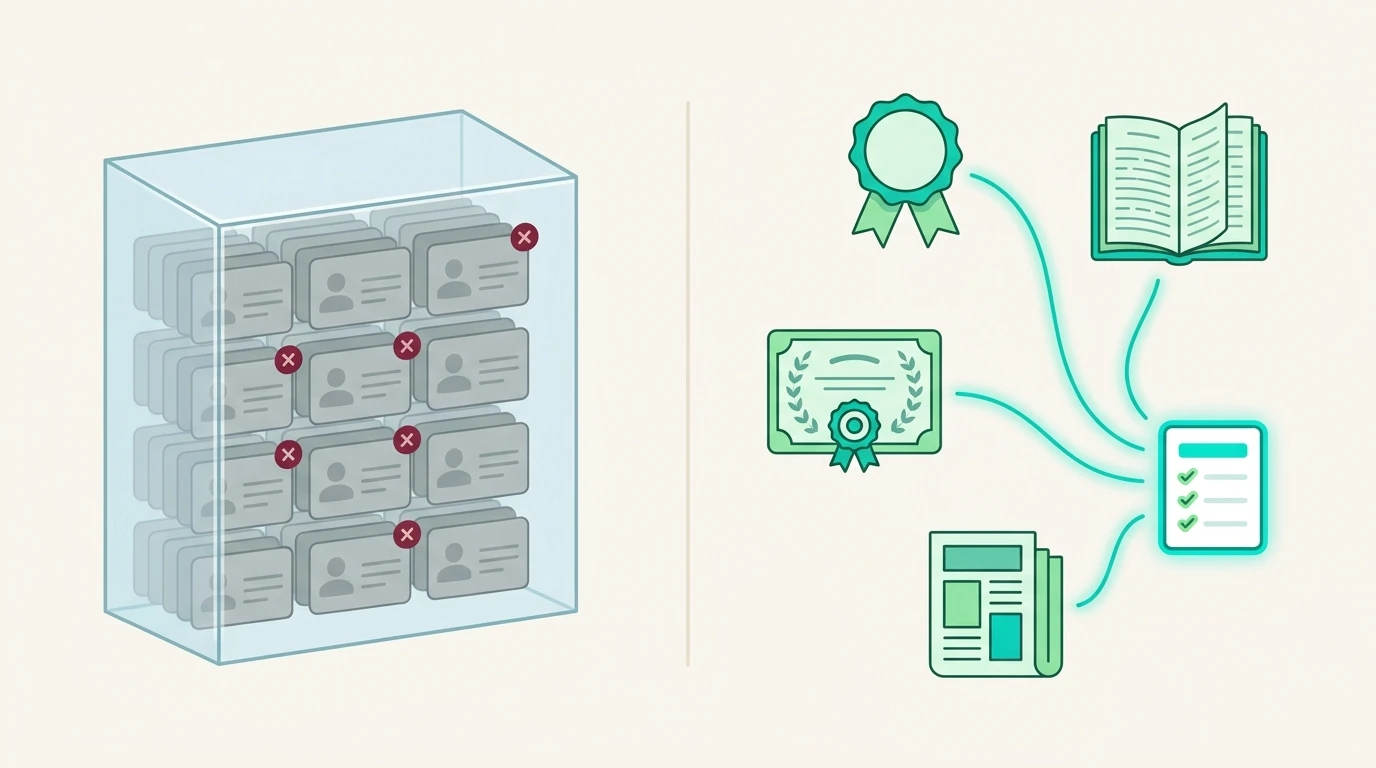
Your competitors have the same Apollo list you do
Estimated reading time: 7 minutes
Open Apollo and filter for sustainability titles at companies over 500 employees. You'll get a few thousand rows. Your competitor pulled the same rows last Tuesday, because they typed the same filters into the same database. Whatever advantage the list was supposed to carry disappeared before anyone wrote a word.
So where does a list advantage come from? The answer changed in the last two years, and it starts with being precise about what a sales database is: a snapshot of LinkedIn, stored and resold.
The database everyone shares
B2B contact data decays at about 2.1% a month, which compounds to roughly 22.5% a year, and the rate climbs toward 70% when you track every field that matters: title, company, email, phone. The mechanism is mundane. Around 30% of professionals change jobs every year, and each move invalidates a record in every database that holds it.
Independent testing shows what that means for a campaign. In February 2026, Amplemarket ran eight data providers through a 231-point evaluation. The reported email bounce rates:
| Provider | Reported email bounce rate |
|---|---|
| Apollo | 20-30% |
| ZoomInfo | 15%+ |
| Lusha | 10-15% |
Amplemarket sells contact data too, so hold the exact figures loosely. But the direction matches G2's user ratings (ZoomInfo scores 8.4/10 on data accuracy, Apollo 7.7/10), and the study's core finding is hard to argue with: database size and accuracy are inversely correlated. The bigger the contact count on the pricing page, the more of your emails bounce, because nobody can continuously re-verify 200 million records.
Decay is the visible failure. Coverage is the quieter one. Apollo and ZoomInfo are built by scraping LinkedIn and corporate websites, which works for VPs at tech companies and poorly for everyone else. Personas that live off LinkedIn (plant managers, event marketers at consumer brands, owner-operators) barely appear. And the filters themselves are proxies. Industry, headcount, and title describe what a company is. Whether it's in market this quarter is a different question, and a snapshot can't answer it.
Lists of what companies actually did
A filter describes what a company is. A record shows what a company did: attended, sponsored, committed, disclosed, bought. Records carry information attributes never will, because behind every record someone approved a budget or signed a document.
Four families of records, with examples from two markets where the records sit in plain sight: sustainability, where we run campaigns, and event sponsorship.
| Source family | Sustainability example | Sponsorship example | What it tells you |
|---|---|---|---|
| Events | Climate Week speaker and exhibitor pages | Attendee lists organizers share with sponsors | They paid to be in the room on this exact topic |
| Registries and deal records | Verra and Gold Standard retirement records | SponsorUnited's 1M+ tracked deals | Money already moved in your category |
| Initiatives and commitments | SBTi dashboard, CDP disclosures, RE100 | Multi-year partnership announcements | A public promise with a deadline |
| News | A new Chief Sustainability Officer, a report release | A product launch, a rebrand, a market entry | Something changed, and budgets follow change |
Some of these deserve numbers. The Science Based Targets initiative publishes a dashboard of 13,860 companies that have set or committed to emissions targets. It updates every Thursday, and you can download it as a spreadsheet with sector, region, scope coverage, and target year. A validated target is a public promise to spend money on decarbonization; the target year is the deadline. CDP adds 22,100 disclosing companies. The Net Zero Tracker finds that 63% of the Forbes Global 2000 now carry a net zero target, and that 385 of them have published no plan for reaching it. A company with a public deadline and no plan is about as qualified as a prospect gets.
Sponsorship has the same physics. A brand on the sponsor page of an event similar to yours has approved a sponsorship budget, built a process for evaluating properties, and staffed someone to run it. The Sponsorship Collective tells sellers to start prospecting from competitor sponsor lists for exactly this reason. And the market has already priced the idea: SponsorUnited raised $35M to track more than a million sponsorship deals across 250,000 brands, in an industry where rights fees passed $97 billion in 2024. Transaction-level intelligence commands that valuation precisely because a title filter can't produce it.
Why nobody mined these records
None of this is hidden. The Verra registry has been public for years. Sponsor pages sit on the open web. So why does nearly every outbound team still start from the same database export?
Labor. When we interviewed sustainability sales teams, manual research ran about 75 minutes per prospect across five to seven tools. The good sources resist scale in a way databases don't: attendee lists arrive as PDFs, six registries use six schemas, and the SBTi spreadsheet gives you a company name with no human attached. There's no export button anywhere.
So teams made a rational trade: a worse list at zero marginal labor beat a better list at 75 minutes a row. The market settled there. Everyone mails the same companies because the good lists don't scale.
Or rather, they didn't.
What agentic search changes
An agent reads the live web the way your best researcher would: it opens the sponsor page, clicks through the paginated directory, checks the registry, pulls the SBTi row, and writes what it found into a table. Clay's Claygent had run more than a billion research tasks like these by 2025. The newer infrastructure goes further. Search APIs like Exa and Parallel accept a plain-language objective ("companies that retired Verra credits in 2025 and carry a 2030 SBTi target") instead of keywords, and their monitoring endpoints watch sources continuously, so the list rebuilds itself when something changes.
The capability that matters most is cross-referencing. A human researcher reads one list at a time. An agent holds four in tension: attended the right conference, and set a validated target, and published no plan, and just hired a Head of Sustainability. By hand, each added condition multiplies the workload, which is why nobody stacked signals manually. For an agent it's one more clause in the query.
The economics have cleared the bar too. Across BCG and Forrester's 2026 surveys, SDR-type agents show the fastest payback of any enterprise agent category: a median of 3.4 months.
The part the vendor decks skip
Agents make things up. Run one across scraped directories without checks and you get confident rows that are wrong, credits burned on failed page loads, and costs that climb at volume. Claygent's own heavy users report all three. Gartner predicts 40% of enterprise apps will embed task-specific agents by the end of 2026, and also expects more than 40% of agentic AI projects to be canceled by 2027. Both forecasts can be true.
So keep a verification layer between the agent and your sending domain: email validation, spot checks, a human pass on anything that reads odd. Bad data at agent speed is just faster bounces.
There's an etiquette line too. Speaker pages, sponsor directories, registries, and published dashboards are public records. Attendee data scraped from a private event app is a different matter, and in Europe a GDPR problem. Organizers will often share attendee lists with sponsors if you ask six weeks out. Ask.
Commitment beats transaction
One finding from our own campaigns matters more than the rest, so I'll close with it.
Rank sources by where the prospect sits in the arc of spending money. A registry retirement looks like the perfect signal, and it is proof a company buys carbon credits. But it's history. The supplier is chosen, the deal is closed, and a fair share of retirements never name the buyer. A commitment runs ahead of the purchase. Across our campaigns and our clients', outreach anchored to a public commitment (a target in a sustainability report, an SBTi validation, a renewable electricity pledge) consistently out-pulls outreach anchored to registry activity. The mirror holds in sponsorship: a brand on a competitor's sponsor page is mid-commitment, budget approved and renewal approaching, which is why that page beats any firmographic filter.
Committed but not yet bought beats already bought. Already bought beats looks like a buyer.
That ranking is most of why we built Emitree. It watches the sources this post describes (SBTi validations, CDP disclosures, registry movement, the language inside sustainability reports) and turns them into researched prospects for teams selling sustainability solutions, compressing the 75-minute research step into minutes. The signals were always public. Reading them at scale was the hard part.
Agents will be standard in outbound within a couple of years; every adoption curve points the same way. When that happens, the advantage moves again, from owning data to knowing which public record predicts a reply. That knowledge comes from running campaigns.
The lists were public all along.
Sources
- Amplemarket - B2B Contact Data Quality Tested: eight-provider bounce-rate benchmark and the size-versus-accuracy finding
- Landbase - B2B Contact Data Accuracy Statistics: decay rates and job-change figures
- SBTi - Target Dashboard: 13,860 companies, weekly updates, downloadable data
- Net Zero Tracker - Net Zero Stocktake 2025: Forbes Global 2000 target coverage and the targets-without-plans count
- CDP - A List 2025: disclosure volumes and scoring
- Berkeley Carbon Trading Project - Voluntary Registry Offsets Database: free aggregated registry data across six registries
- Sponsorship Collective - The Ultimate Guide to Sponsorship Prospecting: competitor sponsor lists and category prospecting
- TechCrunch - SponsorUnited Secures $35M: sponsorship intelligence market coverage
- Parallel - Exa vs Parallel: agentic search infrastructure and monitoring APIs
- Gartner - Task-Specific AI Agents Prediction: agent adoption and cancellation forecasts